
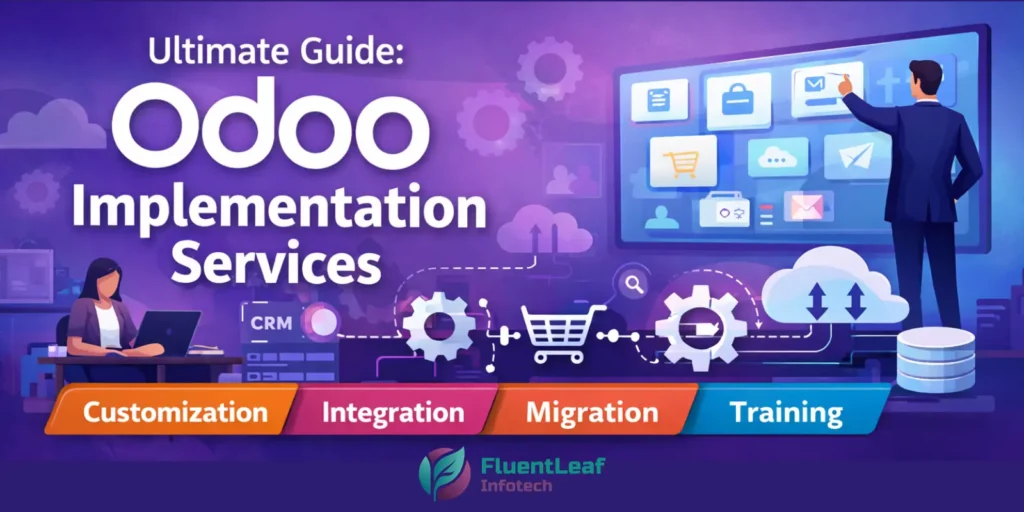
Introduction
Enterprise Resource Planning (ERP) systems are no longer a luxury; they are a necessity for growing businesses. Among modern ERP platforms, Odoo stands out for its flexibility, modular design, and cost-effectiveness.
But simply installing Odoo is not enough. To truly unlock its potential, businesses rely on Odoo implementation services.
This guide explains what Odoo implementation services are, what they include, and how they help businesses maximize ROI; without unnecessary complexity.
What Are Odoo Implementation Services?
Odoo implementation services refer to the end-to-end process of planning, configuring, customizing, deploying, and supporting Odoo ERP for a business.
These services ensure that Odoo:
- Fits your business processes (not the other way around)
- Integrates smoothly with existing systems
- Scales as your organization grows
- Delivers measurable business value
In simple terms, implementation services transform Odoo from a generic ERP into your ERP.
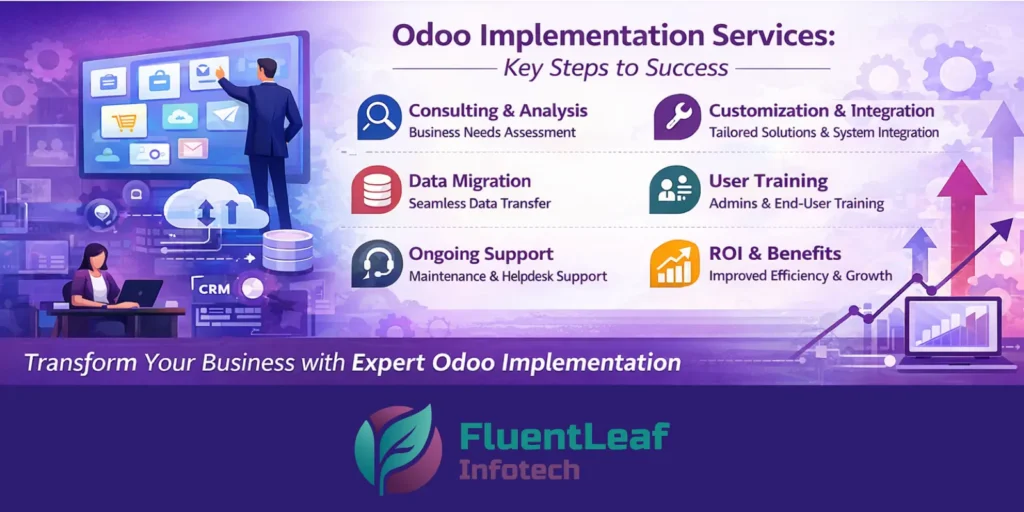
Core Components of Odoo Implementation Services
1. Odoo Consulting & Business Analysis
Odoo consulting is the foundation of a successful implementation. Consultants:
- Analyze your current workflows
- Identify gaps and inefficiencies
- Recommend the right Odoo modules
- Define a realistic implementation roadmap
This phase answers a common question: Odoo vs other ERP systems; why Odoo for your business?
2. Odoo Configuration & Customization Services
Out-of-the-box Odoo works well for many scenarios, but most businesses need adjustments.
Odoo customization services may include:
- Custom workflows and approvals
- Tailored reports and dashboards
- Custom modules for unique requirements
- UI/UX enhancements for better usability
Best practices for Odoo customization emphasize minimal customization where possible, ensuring upgrades remain smooth and future-proof.
3. Odoo Integration With CRM, Ecommerce & Other Systems
Modern businesses use multiple tools. Odoo implementation services often include Odoo integration with CRM/Ecommerce/others, such as:
- Integrate Shopify with Odoo for unified ecommerce operations
- Integrate QuickBooks with Odoo for accounting continuity
- Connect payment gateways, logistics, or marketing tools
Well-executed integrations eliminate data silos and manual data entry.
4. Odoo Migration Services
Switching from legacy systems or older Odoo versions requires careful planning.
Odoo migration services typically involve:
- Data mapping and cleanup
- Secure migration of customers, products, transactions
- Validation and reconciliation
- Post-migration testing
A solid Odoo migration checklist & guide helps avoid downtime and data loss.
5. Odoo Training for Admins and Users
Even the best ERP fails if users are not confident using it.
Odoo training usually covers:
- Odoo training for admins vs users (technical vs operational focus)
- Role-based workflows
- Best practices and daily operations
- Documentation and hands-on sessions
Training accelerates adoption and reduces dependency on support teams.
6. Odoo Support Services & Maintenance
Post-go-live support is critical for long-term success.
Odoo support services may include:
- Bug fixes and performance optimization
- Functional and technical support
- Upgrade and security updates
- SLA-based Odoo support plans explained clearly
Reliable support ensures system stability as your business evolves.
How to Implement Odoo ERP Step-by-Step
A typical Odoo implementation follows these stages:
- Requirement analysis & consulting
- Solution design and module selection
- Configuration and customization
- Integration with third-party systems
- Data migration and validation
- User training and UAT
- Go-live and post-launch support
This structured approach reduces risk and ensures predictable outcomes.
Cost of Odoo Implementation & ROI
The cost of Odoo implementation & ROI depends on:
- Number of users and modules
- Level of customization
- Integration complexity
- Training and support scope
While initial costs vary, businesses often see strong ROI through:
- Process automation
- Reduced operational errors
- Better decision-making via real-time data
- Improved scalability and control
Key Odoo ERP Benefits
When implemented correctly, Odoo delivers significant advantages:
- Modular and scalable architecture
- Unified platform for all departments
- Lower total cost of ownership compared to many ERPs
- High flexibility through customization and integrations
These Odoo ERP benefits make it suitable for startups, SMEs, and large enterprises alike.
Final Thoughts
Odoo implementation services are not just about software deployment; they are about business transformation. From consulting and customization to training, integration, migration, and support, each service plays a vital role in ensuring success.
If you want Odoo to truly work for your business, investing in professional implementation services is the smartest first step.
Need help with Odoo implementation, customization, or long-term support? A well-planned approach today can save years of inefficiencies tomorrow.
📞 Contact us today to get started on your Odoo success journey!