
Implementing Odoo is a major step in your business digital transformation journey. The platform is flexible, scalable, and cost-effective; but the real success of your ERP project depends on one critical decision: choosing the right Odoo implementation partner.
Many ERP failures happen not because of software limitations, but because of poor requirement analysis, wrong partner selection, rushed implementation, or weak technical execution.
This checklist will help you evaluate and select the best Odoo implementation partner for your business; reducing risk, cost overruns, and implementation delays.
Why Choosing the Right Odoo Implementation Partner Matters
A qualified Odoo partner helps you:
- Align ERP with your real business processes
- Avoid unnecessary customization costs
- Select the right edition and modules
- Plan scalable architecture
- Ensure smooth data migration
- Drive user adoption and training
- Reduce long-term maintenance risk
The wrong partner can lead to rework, budget overruns, low adoption, and upgrade problems.
Use the checklist below before signing your implementation contract.
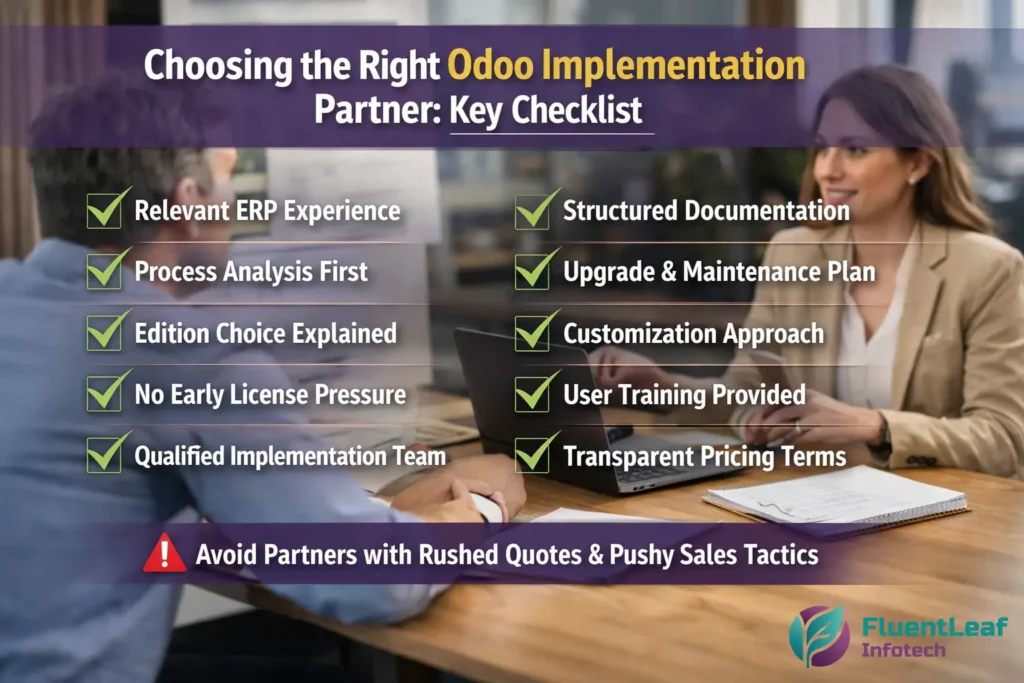
✅ Odoo Implementation Partner Selection Checklist
1️⃣ Check Relevant ERP & Odoo Implementation Experience
Evaluate the partner’s real project experience and not just marketing claims.
Look for:
- Number of Odoo implementations completed
- Experience with ERP (not only websites or apps)
- Projects similar to your business size or complexity
- Multi-company / multi-warehouse / multi-location setups
- Custom module development experience
Industry experience is helpful but not mandatory if the partner has strong functional and technical expertise. A technically sound team with strong process understanding can outperform a domain-only consultant.
Ask for case studies and live demos of delivered systems.
2️⃣ Process Discovery Before Quotation Is Mandatory
A professional Odoo consultant will never give a final quote without process discovery.
They should:
- Conduct requirement workshops
- Understand your current workflows
- Map business processes
- Identify gaps vs standard features
- Suggest configuration vs customization options
🚩 Red Flag for Odoo implementation partner:
Instant quotation without detailed requirement discussion.
✅ Green Flag:
They propose a discovery or gap-analysis phase first.
ERP estimation without process understanding is unreliable and risky.
3️⃣ No Unjustified Push Toward Enterprise or Community Edition
Your implementation partner should explain and not push edition choice.
They should compare:
- Feature availability
- Licensing cost
- App ecosystem needs
- Customization requirements
- Scalability impact
- Long-term ROI
🚩 Red Flags for Odoo implementation partner:
- Pushing Enterprise only to increase license revenue
- Pushing Community only to appear cheaper
- No clear technical justification
Edition choice should be requirement-driven and not sales-driven.
4️⃣ Avoid Partners Who Force Early License Purchase or Hosting
In a proper Odoo implementation lifecycle, you usually do not need production licenses immediately.
Correct flow typically includes:
- Requirement discovery
- Prototype or sandbox setup
- Customization & configuration
- Staging testing
- User training
- Go-live
- Production licensing & scaling
🚩 Red Flag for Odoo implementation partner:
Partner forces license purchase or production hosting before staging, testing, or training begins.
This often signals revenue prioritization over project readiness.
5️⃣ Verify Who Will Actually Implement Your Odoo System
Do not evaluate only the company but evaluate the assigned implementation team.
Ask:
- Who is the lead Odoo consultant?
- Years of Odoo experience
- Functional vs technical expertise
- Number of completed projects
- Senior involvement level
- Availability during go-live
Many firms sell with senior experts but deliver with juniors.
Request a direct discussion with the actual implementer.
6️⃣ Demand Structured Requirement Documentation
Professional Odoo partners produce written scope documents such as:
- Requirement Specification Document
- Process Flow Mapping
- Gap Analysis
- Customization Scope
- Integration Scope
- Assumptions & exclusions
Documentation protects both client and partner and prevents scope disputes.
🚩 Red Flag for Odoo implementation partner:
“Don’t worry, we’ll adjust later.”
7️⃣ Ask About Odoo Upgrade & Maintenance Strategy
Your Odoo system must remain upgradeable and maintainable.
Ask how they handle:
- Version upgrades
- Module dependency control
- Custom module design standards
- Override vs extension methods
- Code documentation
Poor customization practices today create upgrade failures tomorrow.
8️⃣ Evaluate Their Customization Philosophy
Strong Odoo partners prefer:
- Standard features first
- Configuration over customization
- Process optimization where practical
- Minimal but high-value customization
🚩 Red Flag for Odoo implementation partner:
“We can customize anything” without discussing upgrade impact or cost of ownership.
9️⃣ Training & User Adoption Plan Is Essential
ERP success depends on user adoption and not just technical delivery.
Check whether they provide:
- Role-based training
- Department workflows
- Practice environments
- SOP guidance
- Training recordings
- Post-go-live support
No training = low adoption = failed ERP value.
🔟 Transparent Scope, Pricing & Change Request Process
Your Odoo partner should clearly define:
- In-scope items
- Out-of-scope items
- Change request pricing
- Hourly vs fixed deliverables
- Support SLAs
- Response timelines
Transparency reduces conflict and protects your budget.
Final Takeaway: Choose Capability Over Cheap Quotes
The best Odoo implementation partner is not the cheapest but the one who:
- Understands your business processes
- Guides you with technical honesty
- Documents scope clearly
- Avoids unnecessary customization
- Plans for long-term scalability
- Supports user adoption
A good partner acts like a solution architect and not just a software installer.
📞 Contact us today to get started on your Odoo success journey!